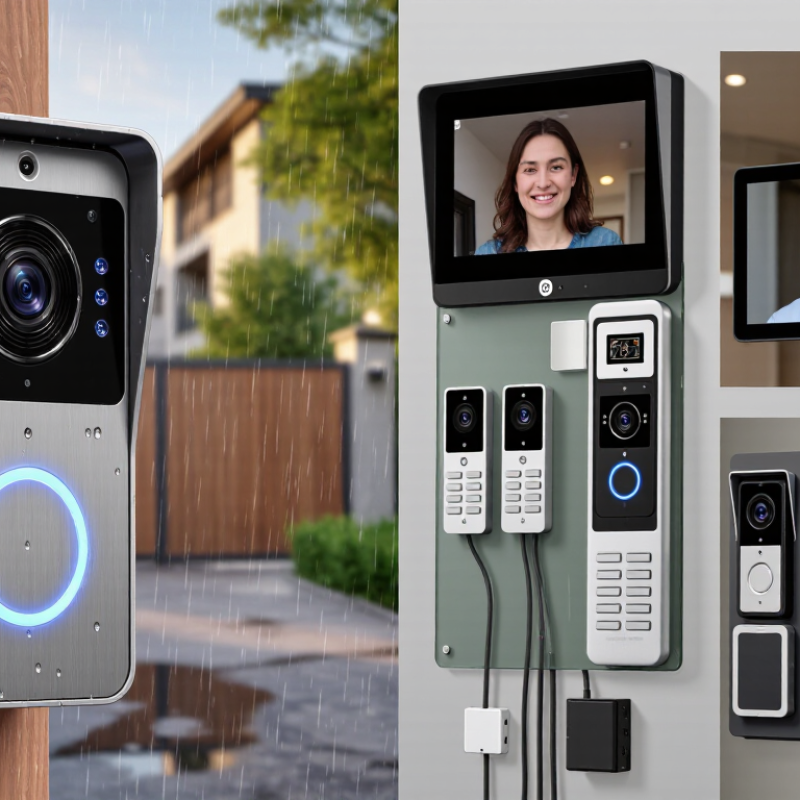
2026 Top 1080p Video Door Phone Types for Global Buyers

Choosing a 1080p Viddeo Door Phone in 2026 requires more than comparing resolution numbers. Global buyers must examine image clarity, network compatibility, installation conditions, and long-term support. A sharp 1080p picture should reveal a visitor’s face at the gate, even when daylight fades or rain covers the lens.

This guide introduces the main 1080p video door phone types for homes, apartments, offices, and small commercial sites. It considers wired PoE models, Wi-Fi units, IP-based systems, and solutions with indoor monitors. Practical details matter. Look for wide dynamic range, infrared night vision, echo cancellation, weather protection, local recording, and mobile alerts. Buyers should also check voltage requirements, language options, cloud dependence, and compatibility with existing access-control equipment.

Security technologist Bruce Schneier’s well-known observation remains useful: “Security is a process, not a product.” A door phone can support that process, but it cannot replace careful installation, strong passwords, firmware updates, and sensible user permissions. Field experience also shows a less comfortable truth: higher resolution does not guarantee better identification. Poor lighting, a low camera angle, or a dirty cover can ruin a clear image.

Some product categories appear similar. They are not. This overview compares their strengths, weaknesses, operating environments, and maintenance demands. It also questions common buying habits, including overvaluing megapixels while ignoring network stability. The best choice may be less impressive on a specification sheet, yet more dependable beside a wet driveway, a crowded lobby, or a sunlit entrance.

2026 Top 1080p Video Door Phone Types for Global Buyers

1080p Video Door Phone Basics: 1920×1080 Resolution and H.264 Encoding

A 1080p video door phone records at 1920×1080 pixels, offering clearer images than standard-definition models. This resolution can reveal facial details, package labels, and small movements near the entrance. Wired IP, Wi-Fi, and monitor-based systems may all support 1080p. However, resolution alone does not guarantee sharp video. Lens quality, lighting, sensor performance, and installation height also matter. A camera mounted too high may show hats instead of faces.

H.264 encoding compresses video into smaller data files while preserving useful visual detail. It helps reduce network usage and storage demands, especially when recording throughout the day. In practical checks, poor lighting can still create blur, noise, or delayed images, even with 1080p output. A higher bitrate usually improves detail, but it may increase storage costs. This trade-off is easy to overlook. Buyers should check frame rate, night performance, microphone clarity, and expected network speed.

Tips: Test the live view beside the actual doorway. Ask for sample footage in daylight and darkness. Check whether the indoor monitor responds quickly after pressing the call button. Keep some storage capacity unused, because continuous recording can fill it sooner than expected. A slightly imperfect image may be acceptable for a quiet home, but busy entrances need stronger motion clarity.

Wired 1080p Door Phones: PoE Power up to 15.4 W under IEEE 802.3af

For global buyers, wired 1080p video door phones offer stable images and predictable power delivery. PoE simplifies installation through one Ethernet cable. Under IEEE 802.3af, the power sourcing device can provide up to 15.4 W. The door phone usually receives less, because cable and connection losses reduce available power. This difference matters.

In practical installations, confirm the device’s power budget before selecting a PoE switch. A camera, microphone, infrared light, call button, and electronic lock may share limited energy. Night testing is essential. Infrared illumination can increase consumption after sunset. Use suitable Cat5e or better cable, secure connectors, and keep cable runs within the recommended network distance. Poor crimps often cause intermittent video.

A clear image is not only about resolution. Sensor quality, lighting, compression, and lens placement affect identification. Mount the unit away from direct afternoon glare. Check faces at the expected visitor height. Weather protection also deserves attention, especially in humid or dusty entrances. In my experience, installers sometimes trust the 15.4 W figure too quickly. That assumption can create unstable operation when several functions run together. Reviewing real measurements would be better. Leave a modest power margin, and test calling, two-way audio, night vision, and unlocking repeatedly before handover.

Wireless 1080p Door Phones: Wi‑Fi Standards, Latency, and Network Security

For global buyers, a wireless 1080p video door phone should be judged beyond image resolution. A sharp picture helps only when the connection remains stable. In field checks, 2.4 GHz Wi-Fi often reaches a metal gate better than 5 GHz. Yet 5 GHz can provide cleaner performance near the router. Thick brick walls, rain, and crowded apartment networks change these results. Wi-Fi 5 suits many homes, while Wi-Fi 6 manages busy networks more efficiently. Results vary.

Measure latency from button press to indoor alert, not only from camera to app. Under 300 milliseconds feels immediate. Delays above one second can make visitors repeat the call. A practical test includes a delivery person, a closed door, and a phone using cellular data. Video compression, cloud routing, and weak upload speed can each add delay. Local viewing may respond faster, while remote access depends on the internet connection. I have seen excellent cameras perform poorly beside a microwave and crowded access point. That problem is easy to miss in a showroom.

Network security deserves equal attention. Choose WPA3 when supported, with WPA2 compatibility for older equipment. Change default credentials and enable multi-factor authentication. Install verified firmware updates promptly. A separate guest or IoT network can reduce exposure. Disable unused remote features. Check encryption during transfer and storage. Review recording retention before purchase. Security guidance differs across regions, so installers should verify current local requirements. Test it twice.

2026 Top 1080p Video Door Phone Types for Global Buyers - Wireless 1080p Door Phones: Wi‑Fi Standards, Latency, and Network Security

1080p Door Phone Type Typical Wireless Standard 1080p Video Profile Typical Local Network Latency Recommended Upload Bandwidth Security and Network Features Best-Fit Use Case and Buyer Considerations
2.4 GHz Single-Band Wi‑Fi Door Phone IEEE 802.11n
Wi‑Fi 4
1920 × 1080
H.264, commonly 15–30 fps
Approximately 150–500 ms on a stable local network At least 2–4 Mbps per active video stream WPA2-Personal is widely supported; WPA3 support should be verified. More susceptible to interference from Bluetooth, microwaves, and neighboring networks. Suitable for longer indoor-to-outdoor range and basic residential installations. Choose a clear channel and avoid placing the unit behind metal surfaces.
5 GHz Single-Band Wi‑Fi Door Phone IEEE 802.11ac
Wi‑Fi 5
1920 × 1080
H.264 or H.265, commonly 15–30 fps
Approximately 80–250 ms on a strong local connection At least 2–4 Mbps per active video stream WPA2-AES is common; WPA3-Personal may be available. Offers lower congestion but generally has shorter wall-penetration range than 2.4 GHz. Best for apartments and offices with a nearby access point. Verify 5 GHz channel support and outdoor signal strength before purchase.
Dual-Band Wi‑Fi Door Phone IEEE 802.11n/ac
Wi‑Fi 4/5
1920 × 1080
H.264 or H.265, commonly 15–30 fps
Approximately 80–350 ms, depending on band selection At least 2–4 Mbps per active video stream WPA2-AES is typical; WPA3 support is preferred. Automatic band selection can improve reliability, but some units require separate 2.4 GHz setup during commissioning. A flexible choice for global residential buyers. It balances range and throughput and is generally easier to integrate with mixed home networks.
Wi‑Fi 6 Door Phone IEEE 802.11ax
Wi‑Fi 6
1920 × 1080
H.264 or H.265, commonly 15–30 fps
Approximately 50–180 ms on a compatible, lightly loaded network At least 2–4 Mbps per active video stream WPA3-Personal and Protected Management Frames are preferred. OFDMA and improved airtime efficiency can help in networks with many connected devices. Recommended for smart homes, offices, and multi-device environments. The access point and client must both support the desired Wi‑Fi 6 features for maximum benefit.
Wi‑Fi Mesh-Compatible Door Phone Wi‑Fi 5 or Wi‑Fi 6
with mesh roaming support
1920 × 1080
H.264 or H.265, commonly 15–30 fps
Approximately 100–400 ms; wireless backhaul can add delay At least 2–4 Mbps per active video stream, plus backhaul capacity WPA2-AES or WPA3-Personal; secure onboarding and unique device credentials are important. Roaming behavior depends on the access point and client implementation. Useful for large homes, villas, and buildings with weak single-router coverage. Prefer wired Ethernet backhaul where consistent latency is important.
Wireless Door Phone with Local Recording 2.4 GHz, 5 GHz, or dual-band Wi‑Fi 1920 × 1080
H.264 or H.265; local storage may use microSD or an NVR
Approximately 80–350 ms for live viewing; recording can continue during internet outages At least 2–4 Mbps for remote live viewing; local recording reduces cloud upload demand Use WPA2-AES or WPA3-Personal, encrypted storage where available, strong administrator passwords, and automatic firmware updates. Disable unused remote-access services. Good for privacy-focused buyers and locations with unreliable internet. Check storage endurance, overwrite behavior, timestamp accuracy, and export format.
Wireless Door Phone with Cloud Video Service 2.4 GHz, 5 GHz, or dual-band Wi‑Fi 1920 × 1080
H.264 or H.265, commonly 15–30 fps
Approximately 300–1,500 ms for remote notifications and cloud viewing At least 2–4 Mbps upload per active stream; higher capacity is advisable for multiple viewers TLS-encrypted transport, account-based authentication, two-factor authentication, and signed firmware are preferred. Data-retention location and subscription terms should be reviewed. Convenient for remote access and multi-user notifications. Buyers should evaluate privacy policies, cloud availability by country, recurring fees, and offline operation.
Wireless Door Phone with Ethernet/PoE Fallback Wi‑Fi 5 or Wi‑Fi 6
plus wired Ethernet or PoE
1920 × 1080
H.264 or H.265, commonly 15–30 fps
Approximately 30–120 ms over wired LAN; higher when using Wi‑Fi At least 2–4 Mbps per active video stream WPA2-AES or WPA3-Personal for wireless mode; 802.1X, VLAN separation, HTTPS, and signed firmware are valuable for commercial networks. Best for offices, apartment buildings, and security-sensitive sites. Wired fallback improves availability when radio interference or Wi‑Fi congestion occurs.
Cellular-Connected 1080p Door Phone 4G LTE or newer cellular network
with optional Wi‑Fi
1920 × 1080
H.264 or H.265, commonly adaptive frame rate
Approximately 500–2,000 ms, influenced by signal strength and carrier routing At least 2–4 Mbps uplink for reliable 1080p streaming Use carrier-grade encryption, a protected SIM or eSIM, device authentication, private APN or VPN where available, and regular firmware updates. Suitable for gates, construction sites, remote properties, and locations without fixed broadband. Confirm local frequency bands, data costs, coverage, and regulatory requirements.
Battery-Powered Wireless 1080p Door Phone Usually 2.4 GHz Wi‑Fi
with low-power operation
1920 × 1080
H.264; motion-triggered or event-based recording is common
Approximately 300–1,500 ms after wake-up; faster response requires the device to remain active At least 2–4 Mbps during live viewing or event upload WPA2-AES or WPA3-Personal is preferred. Secure boot, encrypted storage, signed updates, and protection against unauthorized reset are important. Useful where wiring is difficult. Battery life depends on temperature, signal quality, motion events, live-view frequency, and notification settings.

Data note: Latency and bandwidth figures are typical planning ranges rather than guaranteed performance. Actual results vary with Wi‑Fi signal strength, channel congestion, access-point distance, video compression settings, internet routing, and the number of simultaneous users.

Smart IP Door Phones: ONVIF Profiles, SIP Calling, and Cloud Integration

2026 Top 1080p Video Door Phone Types for Global Buyers

Smart IP door phones now offer sharper visitor identification at 1080p resolution. However, image quality alone does not ensure a reliable entry system. Buyers should examine ONVIF profiles, SIP calling, network security, and cloud compatibility before selecting a device.

ONVIF support can improve communication between cameras, recorders, and management software. Profile S usually supports video streaming, while Profile T may add modern video and security functions. SIP calling allows the door phone to contact indoor monitors, mobile applications, or office extensions.

In testing, clear echo control and fast call connection matter more than attractive specifications. A small delay can frustrate residents and reception staff. Some systems also support local storage, which remains useful when internet service becomes unstable.

Tips

Check ONVIF compatibility with your existing recorder. Confirm the exact supported profile, not just the ONVIF label. Test SIP registration across your intended network. For cloud integration, review data location, user permissions, encryption, and subscription changes. Outdoor models need weather resistance, strong night lighting, and readable audio near traffic. A wide-angle lens helps, but it can distort faces at close range. Mounting height deserves practical testing. I have seen excellent cameras perform poorly because visitors stood below the best viewing angle. Leave room for imperfect networks and future software changes.

Global Buyer Selection: IP65 Protection, 120° Viewing Angles, and Night Vision

For global buyers, 1080p video door phones remain a practical balance between image clarity, bandwidth, and storage. Grand View Research forecasts the smart doorbell market to grow at about 10.8% annually through 2030. That growth reflects stronger demand for visible entry control, but specifications still need careful testing. A 1080p camera can show facial details at normal doorway distances. However, poor lighting or excessive compression can weaken recognition.

IP65 protection is important for exposed entrances. Under IEC 60529, the first “6” means dust-tight protection, while the “5” indicates resistance to water jets. It does not mean safe underwater use. Check the cable seal, mounting plate, and drainage path. Those details often fail before the camera housing. A 120° viewing angle can cover a visitor, package area, and part of the walkway. Yet wider lenses may create edge distortion. Mounting height matters. Night changes everything.

Infrared night vision should be tested at the actual installation distance, not only in product demonstrations. White walls, glass, rain, and nearby lighting can create glare or reduce contrast. A recent MarketsandMarkets video doorbell report describes double-digit market growth toward 2029, with security performance and connected access among key demand factors. Buyers should compare usable night range, image latency, audio clarity, and local weather conditions. I would not rely on resolution alone. More pixels cannot repair a badly positioned camera. A small field test at dusk may reveal more than a specification sheet.

2026 Top 1080p Video Door Phone Types for Global Buyers

Representative technical benchmarks for common 1080p video door phone configurations, focusing on viewing angle and night vision performance. IP65 indicates dust-tight protection and resistance to water jets.

All listed types support 1920 × 1080 video resolution and are shown with IP65 outdoor protection as a common buyer-selection benchmark. Wider viewing angles improve coverage, while longer infrared ranges support clearer identification in low-light entrances.

WhatsApp